
I bought a Sony a6100 in 2022 as a way to dip my toe to into mirrorless. I used a Nikon D750 as my primary camera at the time, had recently added a D500 for sports and wildlife, and had tried Nikon’s mirrorless system through a used Z50. I was nonplussed with Nikon’s mirrorless autofocus and wanted to try Sony’s leading-edge system, finding a lower-cost way to do it in the form of the a6100.
By 2023 I had sold off the Z50 and replaced the D750 / D500 with Nikon’s mirrorless Z8, but still kept the Sony around. That was partly because I learned from my Canon experience that I should never sell back a camera system and partly because the a6100 was still genuinely usable. While I don’t enjoy it as a daily driver, its small size makes it a great camera for travel. It’s one of my less expensive cameras and I have a minimal investment in lenses, which limits the impact if something bad were to happen to it. I brought it with me on a Royal Caribbean cruise in 2024 and brought it to Florida recently over April break.
Since it’s mostly a travel camera, it spends much of its time in my photo closet. Digging it out for my April trip required me to reacquaint myself with its ergonomics, functions, and lens collection. Here are my random thoughts after using it for the past month.
Ergonomics
I like to control placement of the focus point and the a6100’s lack of a thumb stick makes that difficult. Because each edge of the D-pad is assigned to other functions, focus point movement is implemented as a mode enabled or disabled via another button. I changed the mode assignment from the function button next to the shutter to the center of the D-pad, which has made it a bit easier to move around. I’ve also been using the touch screen to set the focus point. I still find it awkward, but it can help in some situations.
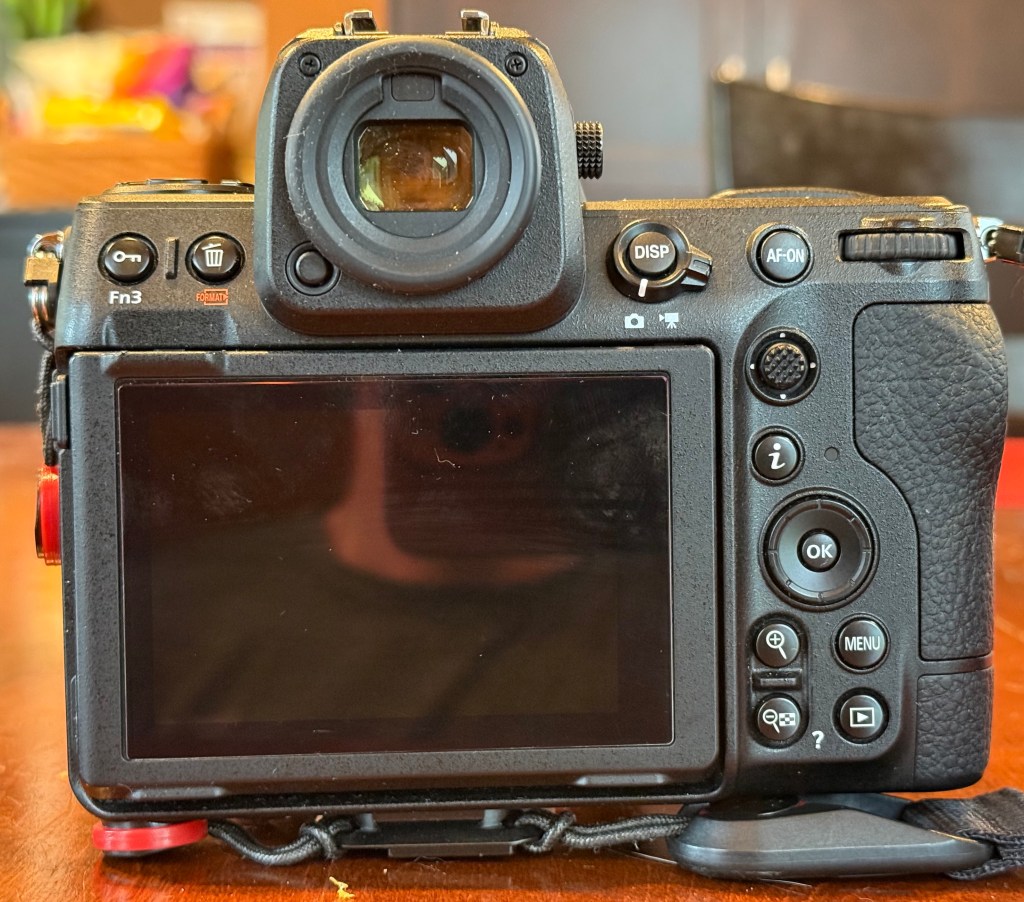
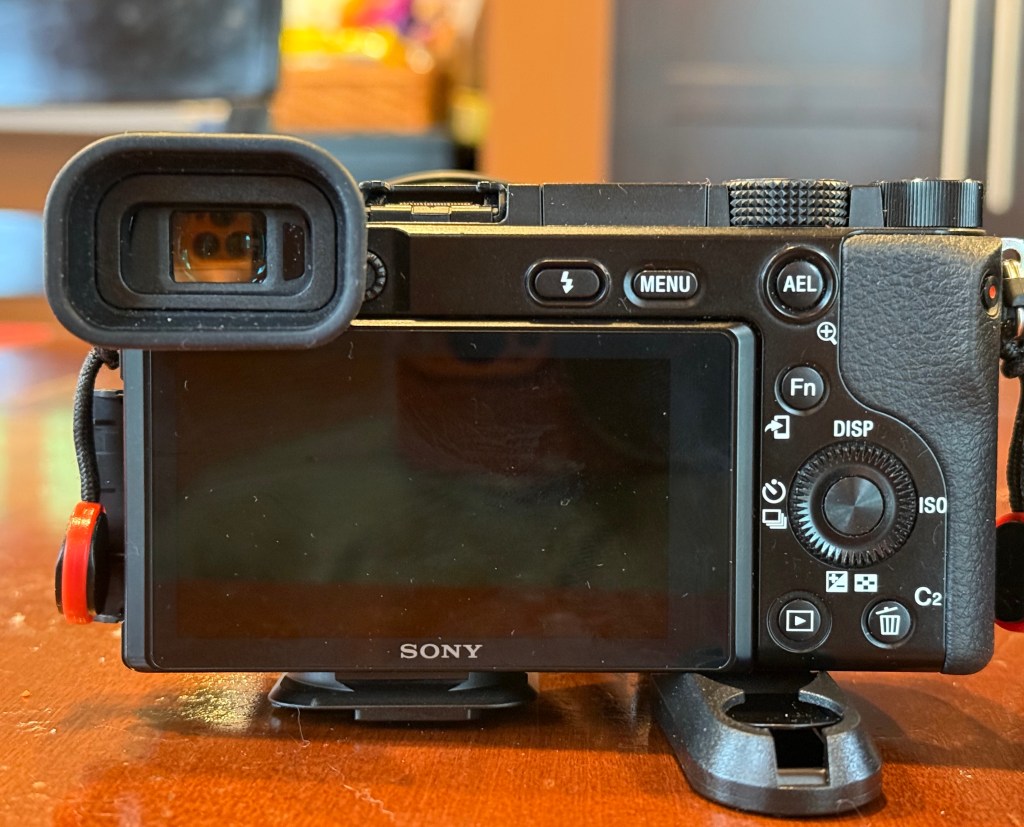
Speaking of awkward, the ergonomics of the a6100 are awkward all around. I appreciate that it’s a small camera that is easy to carry around with a small lens, but it continues to be a struggle for me to use. The buttons are small, the body is mostly flat, the grip is too narrow, and everything is too close together. I don’t mind the off-center position of the EVF, but that said, I’ve noticed myself using the rear screen more often because it’s easier than contorting my face toward the viewfinder. It’s not a complaint as much as an observation – this is the cost of having something so small. For comfortable shooting I prefer my Z8 or a DSLR with some grip and contour.
Shutter & Lenses
I forgot how loud the shutter is. In my initial review I noted that it’s as loud as the shutter on my high-end D500 DSLR. It’s a jarring sound coming from such a small camera, especially at 11 frames per second! I’ve had it on my desk for many weeks now and tend to put it in electronic shutter mode because I find the mechanical shutter so disruptive.
I don’t have a lot of lenses for it, which is intentional. It’s not my main camera so I only invest in physically small lenses to keep it easy to pack. I picked up a 75mm f/1.8 prime a couple of years ago from the Chinese company Samyang, and used it a lot on my recent trip. It’s small, light, and inexpensive, but created some really great images.

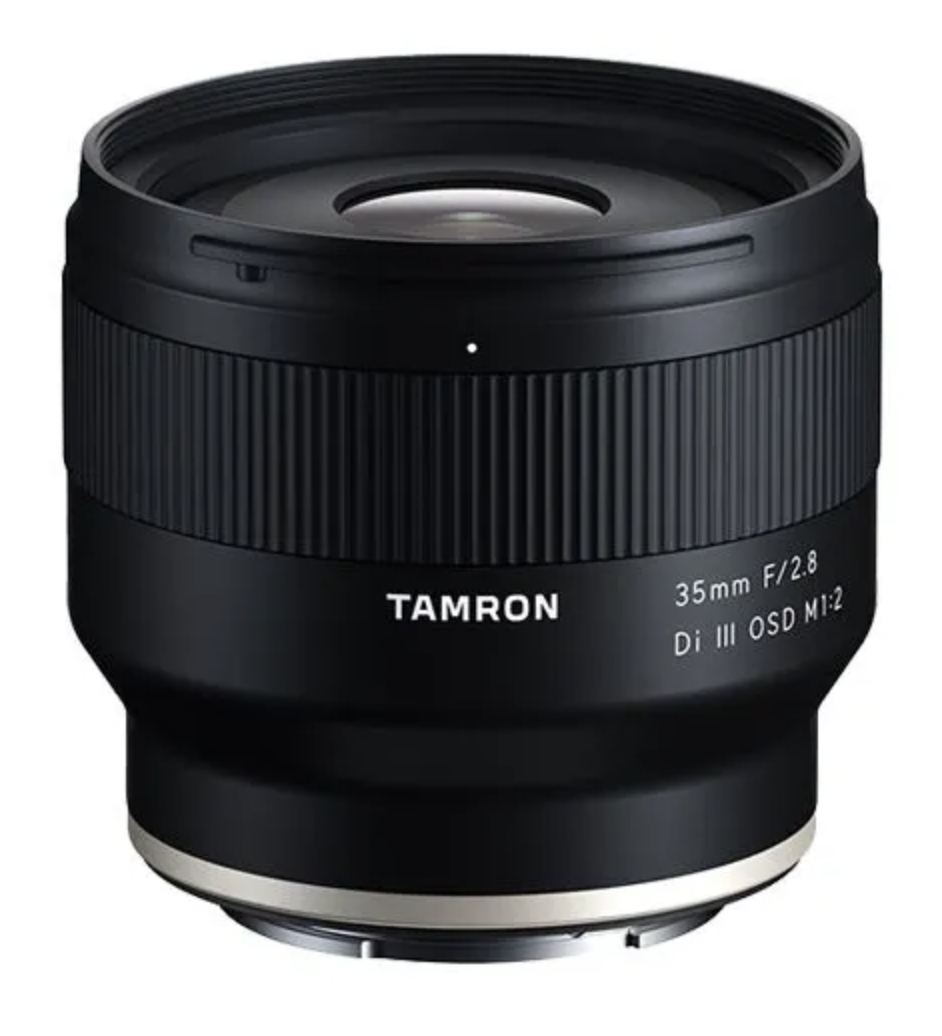
Having spent a bit more time with it I decided to make a small investment in lenses, buying a used Tamron 35mm f/2.8 prime for $130. I already have a great Sigma 30mm f/1.4, but the Tamron acts as a 1:2 macro, which interested me. I looked at Sony’s 30mm 1:1 macro which sell for about the same price, but it’s only good for macro work and doesn’t do well as a walk-around lens. Tamron’s model, while not providing full macro magnification, is a much better lens for walk around. That’s where I’d use it: on a trip where I might want a close up on occasion. If I want to do full macro work I’d use my Z8 anyway.
Still Competitive
Despite being five years old, the a6100 is still competitive with current mirrorless cameras like Nikon’s Z50 II. The autofocus was advanced for the time and is still very competitive today. Image quality across the industry hasn’t changed much and the a6100 offers good noise control and high dynamic range. Its continuous shooting speed at 11 fps can still keep up as well. Much of this is due to Sony’s market positioning of its crop sensor cameras: providing the same set of image quality, autofocus, and continuous shooting capabilities across three models, with differences in body construction, EVF, and image stabilization. The a6100 has all of the high-end features of its more expensive siblings at the cost of a more plastic construction, low-end EVF, and lack of image stabilization. That’s a compromise that’s worked very well for me for what I use it for.
While the a6100 provides high image quality, I still notice an immediate difference from my full frame cameras. There’s just something grittier and noisier about APS-C images, even those at low ISOs. It’s not specific to the a6100 either, I notice this graininess in images from my crop-sensor Canons as well as my D500. The verdict is that I wouldn’t bring a crop-sensor camera along to capture my best technical work, but for vacations it’s fine.


I continue to be amazed by what AI noise reduction can accomplish. I usually shoot images in manual mode so that I can lock the shutter and aperture to what I want and let ISO float around to ensure proper exposure, but sometimes I forget to modify one or the other, resulting in higher than intended ISOs and noise. I took a few sets of images at 1/4000 by mistake, which drove ISO to 12,800 and generated a lot of noise. DXO PureRAW 4 to the rescue! Less than a minute of processing resulted in an incredibly clear and crisp image. There may be a bit of AI hallucination in some of the finer textures, but you can’t tell if you aren’t pixel peeping. And anyway, I wouldn’t have some of these images otherwise. Now that’s AI I can get behind.
 Relatively Ambitious