
I enjoy reading old magazines and enjoy looking at their ads as well. There’s something about the way they’re pitched – the images, the layouts, the specs – that still gets me. I often fall into the trap of looking at the prices and marveling at them, thinking about how “cheap” or “expensive” various systems are. I often forget to adjust those feelings for inflation, so I decided to do it with a 1999 ad from Mac Mall.
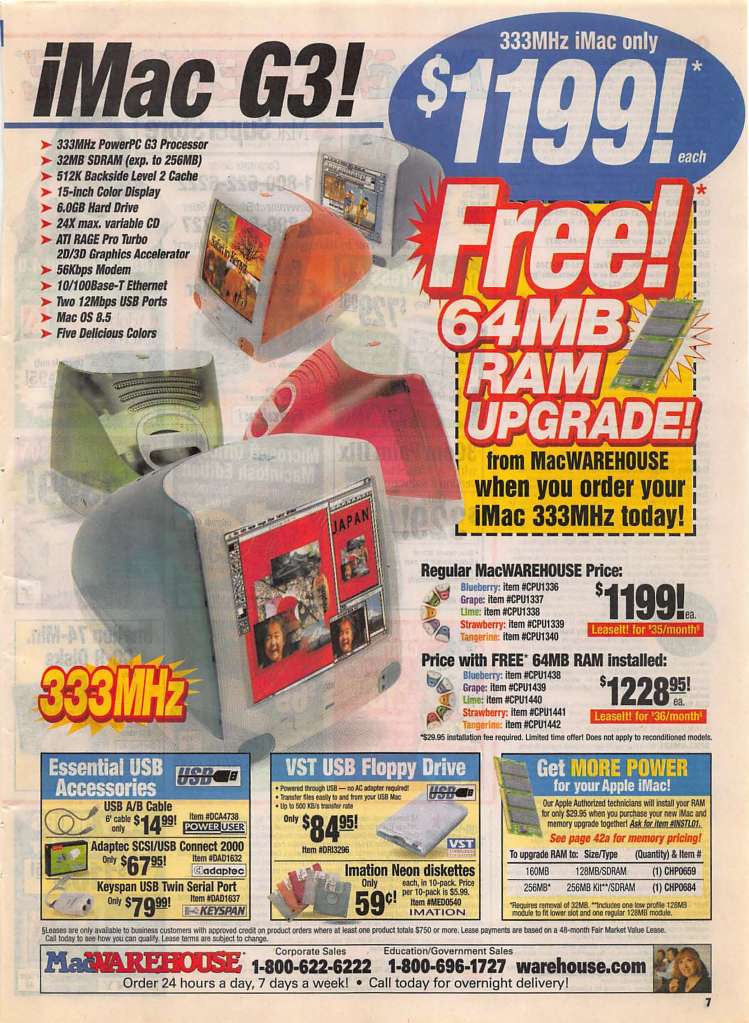
Let me set the stage: the iMac was in its first major generation and had just been expanded to include five colors. The PowerPC G3 was king, running at up to 400 MHz in Apple’s Power Macs. RAM sizes of 32 MB were standard, paired with 4 – 8 GB hard drives. LCDs were rare and expensive; CRTs sat atop nearly every desk. The USB transition was in full swing and seemingly every accessory was offered in some form of translucent colored plastic.
This ad largely covers the five flavors of iMac, selling for $1,199, a $100 drop from the original 1998 Bondi Blue model. Mac Warehouse offers a “free” 64 MB RAM upgrade after a $29 installation fee, typical of these catalogs in the day. At least they come clean about the full price toward the bottom of the page. USB accessories are included as well: a floppy drive (a must), transparent colored floppy disks, a USB cable, USB-to-serial adapter, and a USB-to-SCSI adapter. The iMac price seems pretty stable more than 25 years later: today’s 24 inch M4 iMac starts at a similar $1,299.
But that was then and this is now. The interesting thing about computers is that while they’ve significantly increased in performance and features, they’ve actually dropped in price, even before inflation is considered. Take the PowerBook G3 of this era, whose entry level price was $2,499. Compare that with today’s M5 MacBook Pro, which starts at $1,599. But that’s not the entire story. When factoring in inflation, the price drop is even stronger.
The table below shows the major products in this ad adjusted to 2025 prices. The bargain basement 1999 iMac suddenly costs more than an entry level Mac Studio today or as much as a 24″ iMac tricked out with 32 GB RAM and 1 TB storage. That USB cable turns out to be much more expensive than the $8 USB-C cables we’re used to, and a 1.44 MB floppy drive costs more than a 2 TB Samsung SSD with 1.4 million times more storage! The only exception here is the USB-to-SCSI adapter: if it were available new, even at the inflation-adjusted price, it would be cheaper than what it costs on the used market.
| Product | 1999 Price | 2025 Inflation Adjusted |
|---|---|---|
| 333 MHz iMac G3 | $1,199 | $2,364 |
| USB A/B Cable | $14.99 | $29.56 |
| Adaptec SCSI USB Connect | $67.95 | $133.99 |
| VST USB Floppy Drive | $84.99 | $167.59 |
| Neon Floppy Disks | $0.59 | $1.16 |
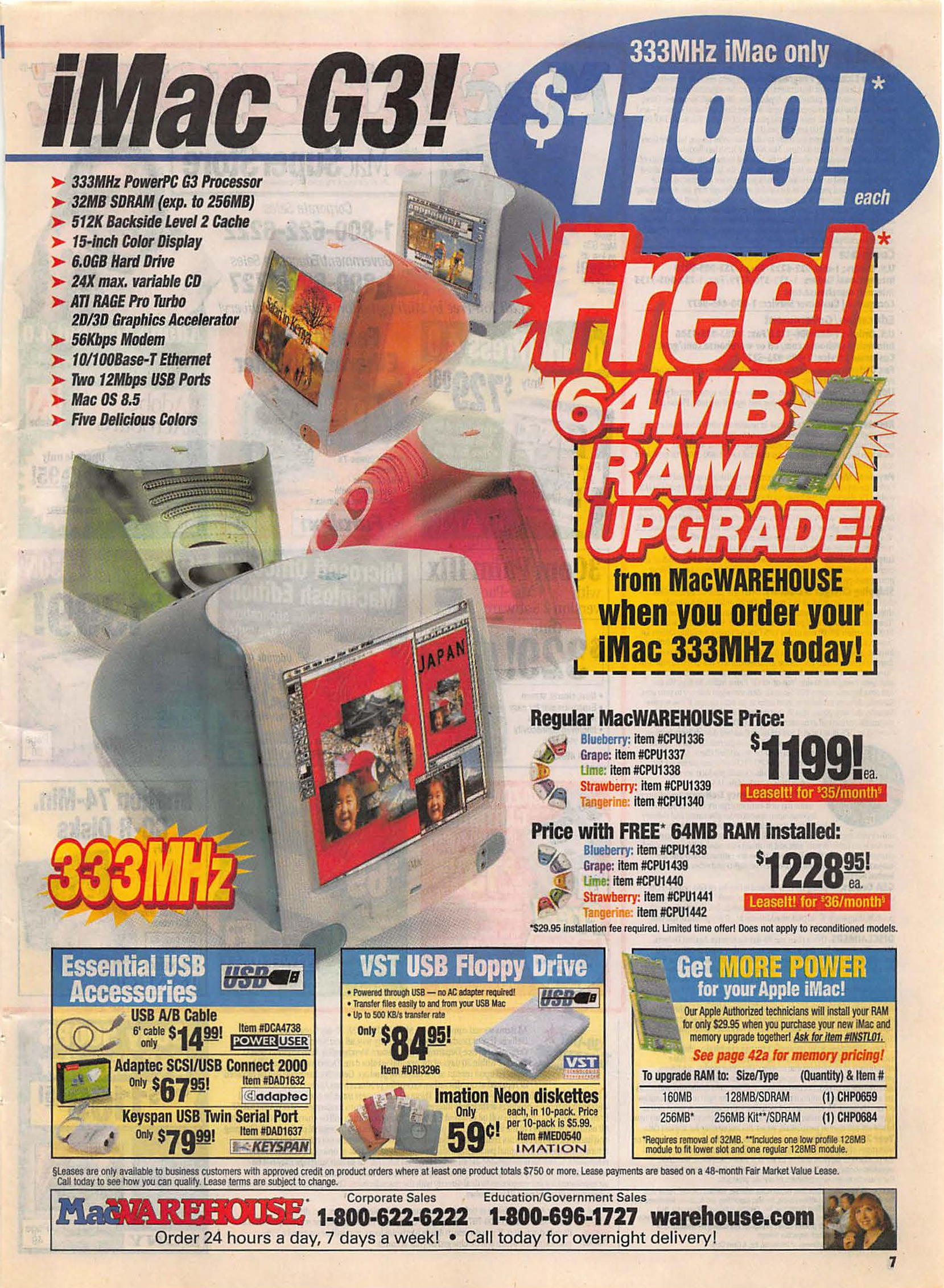
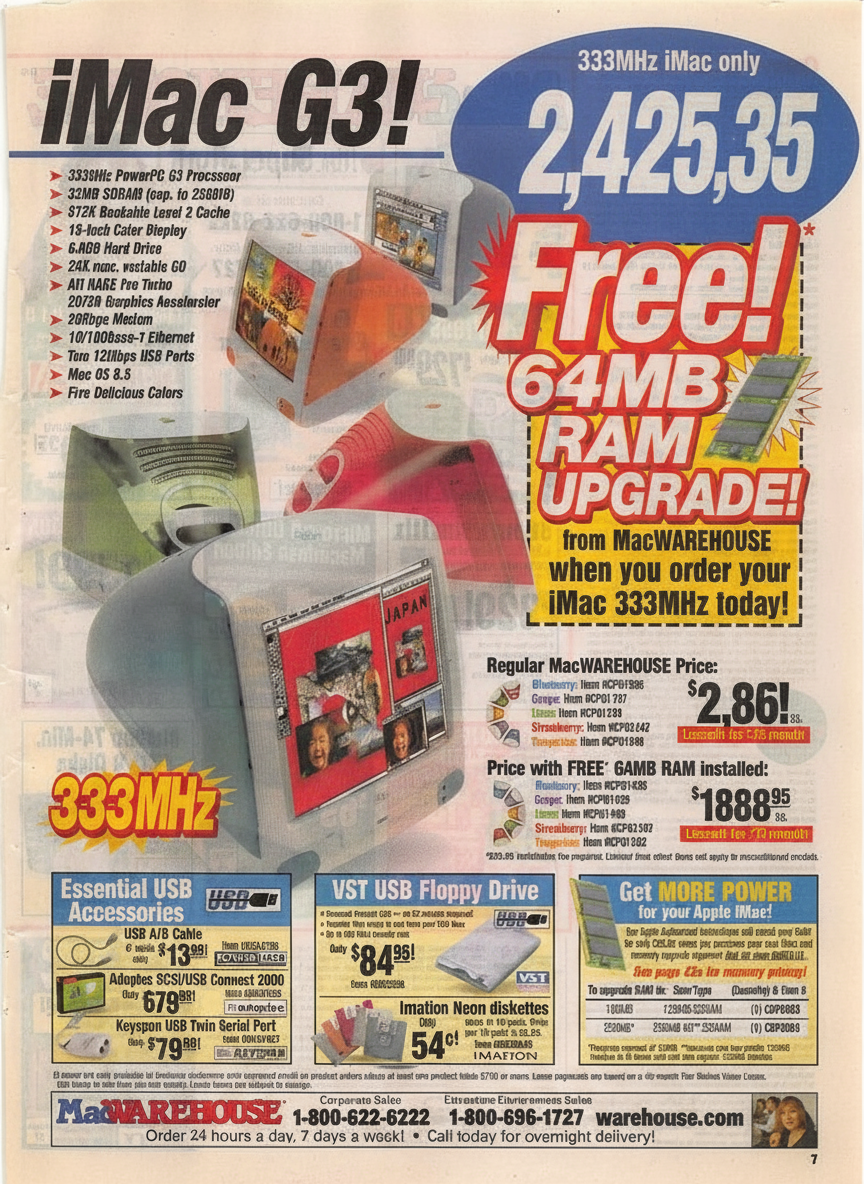
Just for fun, I decided to ask Google’s Nano Banana image model to update the ad and adjust the prices for inflation. It did… a job. The iMac’s price is close to what I came up with if you can forgive the comma instead of decimal point but I’m not sure what’s going on with the three digit price in the “Regular Mac WAREHOUSE Price” section. Things fall apart at the bottom, with SCSI adapter becoming way more expensive, the USB cable and floppy disks becoming cheaper, and the floppy drive remaining the same. At first glance it limited the edits to price changes, leaving the structure, images, and even text alone. This has historically been difficult for image models and impressed me at first.
Look closer, of course, and as with many AI-driven results, small issues start to emerge. The overall detail in the AI version is blurry compared to the original, but that’s not the worst of it. Try to read the text. It looks correct if you read it quickly, but look closer. Some of the text is correct, but other text is garbled. The iMac’s been upgraded from a 333 MHz to a 3338 H processor. It has 32MB SDRAA8, an S72K Bookahte leset 2 Cache, and an 18 loch Cater Biepley. Sounds… fancy. Bigger text seems to survive, but smaller text suffers.
Even so, it took me about 20 seconds to get this result and I’m impressed with its look at a glance. It’s a visual reminder that the price of technology has not only decreased over time but the purchasing power required to acquire it has decreased as well. In a world where prices increase and buying power decreases, this is pretty rare.
 Relatively Ambitious