
While I’ve been really excited lately about getting a new camera, I realize that it’s not the gear that makes the photo, it’s the technique and the art. As such, I’ve continued trying to expand my skill set into other areas of photography I haven’t tried yet. In this case I decided to try astrophotography. I didn’t want to arrange an elaborate trip to some remote location to take photos of the stars, so I tried my back yard.
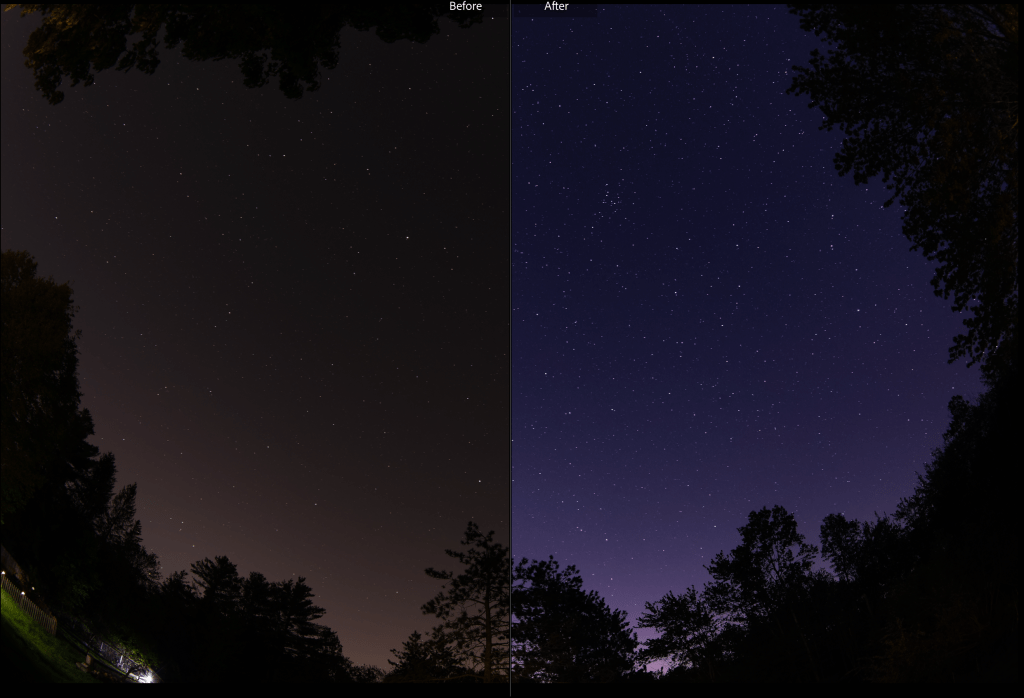
I went out on two separate nights when the sky was clear and spent about 30 minutes each time with my tripod and D750. I wanted to bring my higher-resolution D800, but I chose the D750 due to its flip down screen and better Live View. Now I’ll be honest here – these are very processed images. They represent my desire rather than my reality. I’ve creatively changed the color and detail of the sky, removed unwanted light sources, enhanced detail, and significantly brightened the stars. I expect to capture much better images that better represent reality as I improve.
Anyway, even with all of the processing, I think these are pretty cool. I also experimented with noise reduction a bit – one image has none, one uses Lightroom’s new AI reduction, and one uses DXO Deep Prime XD. I like them all. The image without noise reduction isn’t very offensive and the Lightroom and DXO processed images are pretty close. The DXO image might be a tiny bit more detailed and the RAW file is about 25% smaller, but Lightroom isn’t bad for “free”.
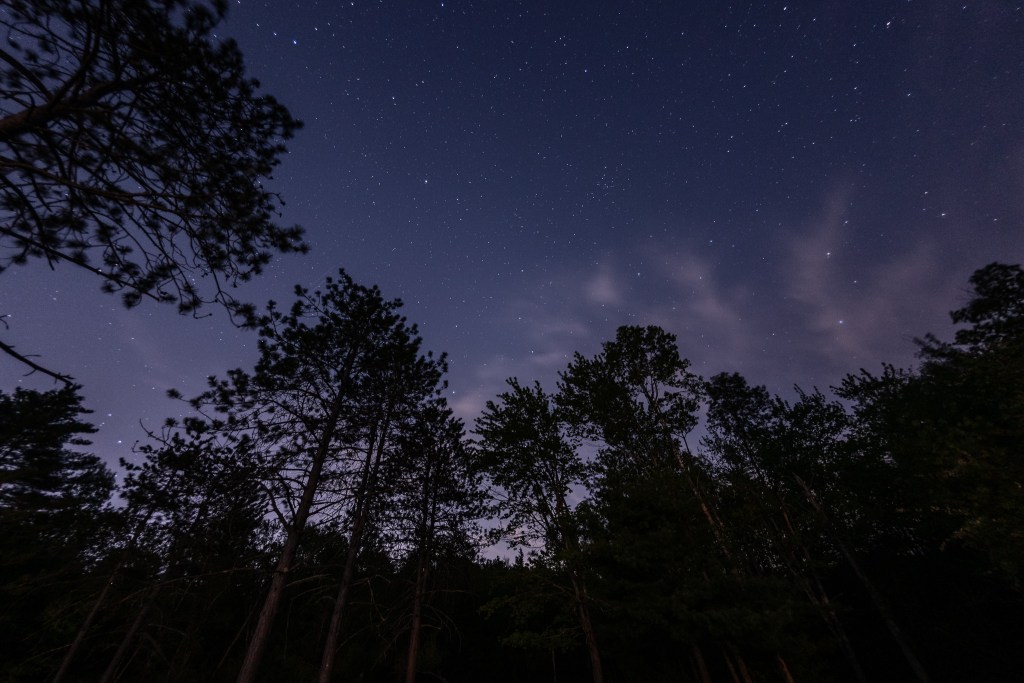
I took this in the middle of my backyard in front of the boys’ swing set. I’ve taken this shot many times before in the daylight to highlight our fall leaves. This was taken with my 16mm fisheye, but Lightroom corrected the extreme distortion. I don’t love it and always forget to disable it because it stretches the edges. But here it is anyway, a 20 second exposure f/2.8 at ISO 800 with Long Exposure Noise Reduction enabled in the camera. I’ve applied no additional noise reduction to this image, and while it does have some noise in the sky, I don’t find it distracting.
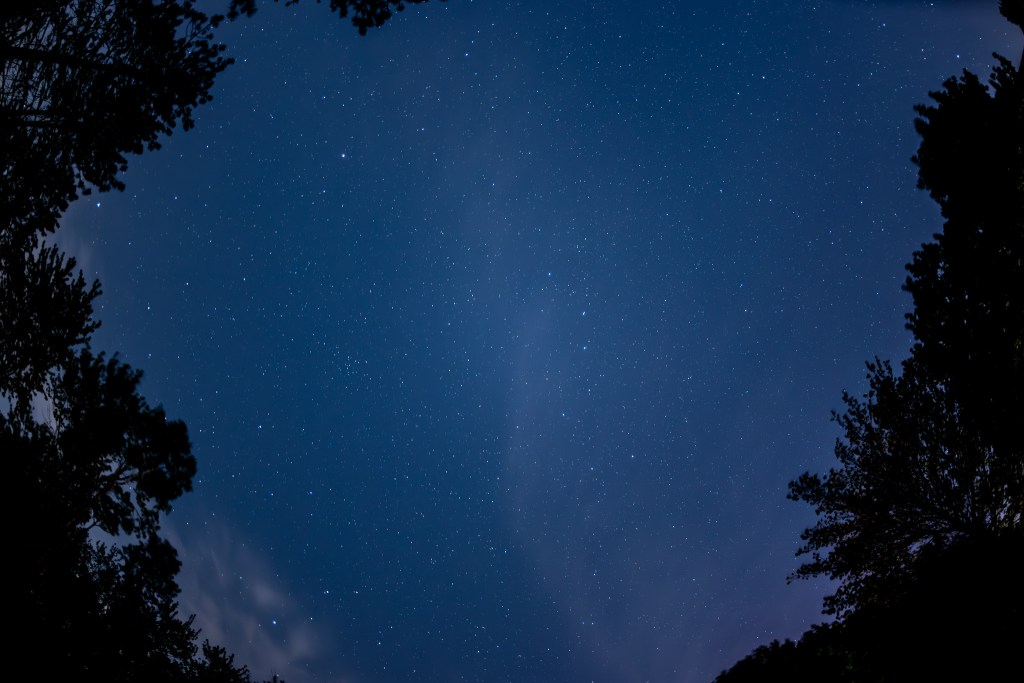
This image is taken from the same spot as the first, but with the camera pointed upward and Lightroom’s distortion correction disabled to show the full field of view from the lens. I used this lens purposely to warp the trees into a frame for the sky. This is a 30 second exposure at f/2.8 and ISO 800, also with Long Exposure NR enabled. I’ve processed this using Lightroom’s new AI-based denoise. It’s very clean. While the first image doesn’t bother me, this one looks buttery smooth. It’s very impressive because I wasn’t sure how Lightroom would deal with an image whose subject (stars) already looks like random noise.
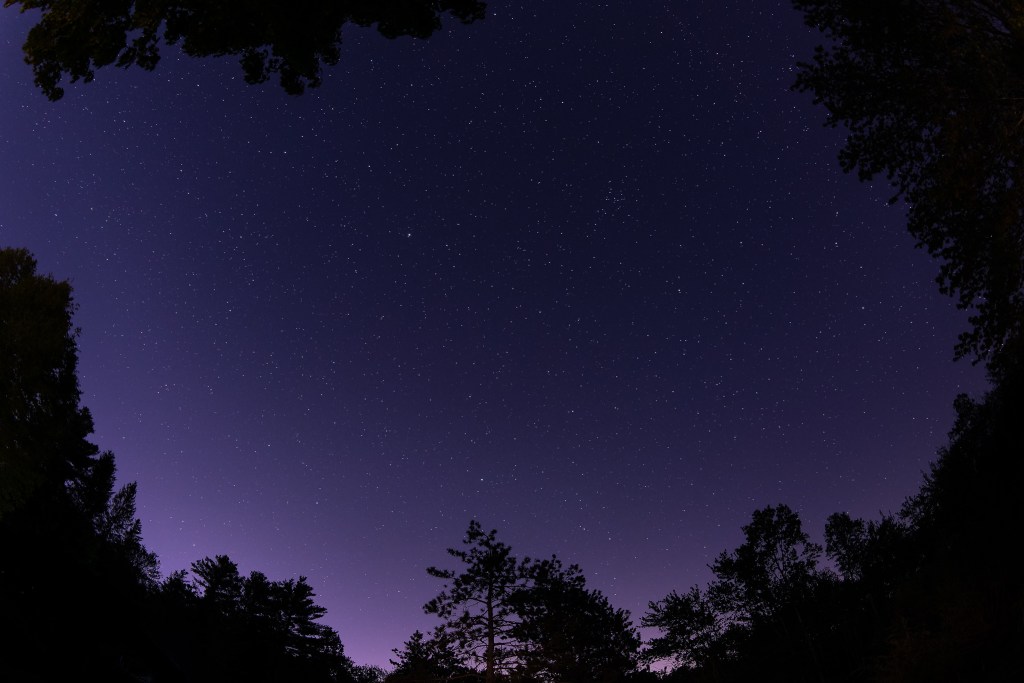
On my first nighttime outing I was a bit reluctant to go too far into the dark, even in my own yard. I need to get used to being out in the wilderness a bit first, so I started in a safe place: my deck. This has similar framing to the previous image, but with more trees wrapping around due to the elevation of the deck and its proximity to additional trees. The exposure is 30 seconds at f/5.6 ISO 800. I once again enabled noise reduction in the camera itself and applied additional reduction in post in the form of DXO PureRAW’s newest Deep Prime XD model. It’s very clean, just like the Lightroom version, but perhaps a bit over-sharpened at the treeline due to high sharpening settings I was testing.
The Sky is Fake
As I said, these images are highly edited, starting with the color of the sky. I played with the white balance until the images looked pleasing to me, not until they looked the way I saw them. There were no bright blue or purple skies those nights and I’m OK with that. The color captured in the original images wasn’t accurate either, sometimes looking almost black and white, but it wasn’t nearly as rich as these are.
Learning is Fun
I learned a bunch from just two nights of astrophotography. I learned that having a timer is very helpful and am glad I brought one. I learned that focusing on stars in the dark is extremely hard, even with Live View to help me. The stars in these images are not super sharp upon close inspection (even with all the enhancements) because of one or two things (probably both). Focus was a challenge and I was never sure if I had it or not, even after zooming in significantly onto a single star in Live View. There might have been a bit of camera shake due to wind – my tripod was on soft grass and I didn’t weigh it down. The stars also move, and can blur on shutter speeds as “short” as 15 seconds.
I used Long Exposure Noise Reduction for every shot, which added a bit of time to my photo sessions. Long Exposure NR is built into the camera and compensates for noise that accumulates on the sensor during long exposures. I’ve read that it’s pretty good since it is programmed by Nikon and customized for the particular sensor in a given camera, but it takes a while to run after every shot. My camera was unavailable for at least 10 seconds after every image. It wasn’t the end of the world, but it slowed me down. I’m going to try some images without it just to see if it’s worth the processing time or if AI noise reduction can take care of it for me.
What’s Next?
I have plenty of technique to improve – focusing, steadying my tripod. I’m going to take additional images in my back yard, but plan to hit up some other areas as well. I want to put something in the foreground that isn’t black or dark trees. I’ve seen a lot of astrophotography images with cool rocks, buildings, and water features in the foreground that I’m inspired by. I’ll also be camping in June, which is the perfect time to slip away from the fire from a bit to snag some sky photos.

