
In the last installment we reviewed the Butterfly Keyboard and iTunes 13 vaporware. In this edition we’ll look at Intel Macs, angry engineers, and AI.
Intel Macs
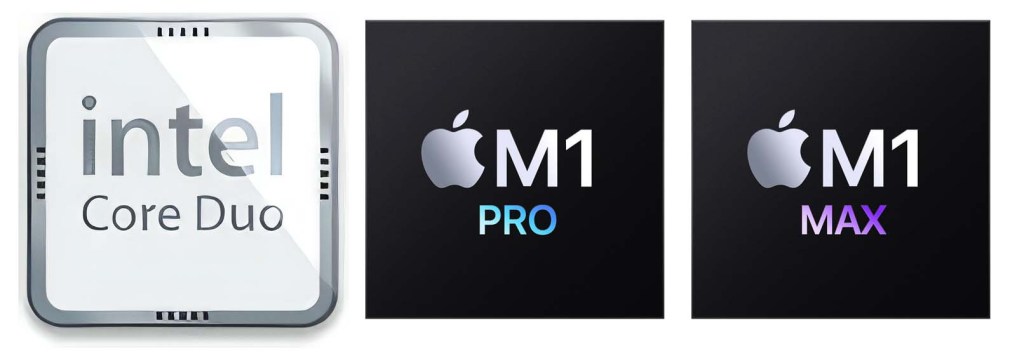
Apple completed the transition to Intel in 2006 and Simple Beep celebrated in its January 2016 episode with a look back at the transition. They made some interesting comments and predictions in the episode that are fun to reflect on today. Remember that this was nearly a decade ago:
- They mentioned that before the first Intel macs shipped, people were worried that they’d be super loud with fans running constantly to cool them. That turned out not to be an issue for many years after the transition but became significant during the last half to third of the Intel era. I used a 15” i9 machine from 2018 at work for several years. Its fans spun up audibly after two minutes of use and didn’t stop until the lid was closed. As Intel crammed more cores into its CPUs to scale performance, constant fan noise and reduced battery life became a common criticism of Mac users.
- Based on Apple’s history of architecture changes (roughly every decade), they predicted that Macs wouldn’t be packing Intel CPUs 10 years in the future. They were right: the Apple Silicon transition occurred four years later!
- They discussed the Apple ARM rumors that were floating around at the time, noting that the iPad Pro’s A10 performed similarly to a 12” MacBook. Four years later Apple shipped a developer machine using the A12Z and then its first products using the M1, completely blowing Intel out of the water.
- The conversation was framed from the perspective of large transitions, and they expected Apple to mandate the use of Swift for app development. Ten years later that still hasn’t happened. They mentioned it again later in the year when talking about Swift 3.0.
WWDC & AI
Episode 40 covers Apple WWDC events, starting with a 1997 Q&A before Steve Jobs was even the interim CEO. It’s a rare and intimate session: Jobs has little to lose in his advisor role and his reality distortion field can’t seem to reach all the way to the back of the auditorium.
I’m struck by the video of this for several reasons. One is the make up of the group – it’s 1997 and nearly every attendee is a white male, many rocking the ill-fitting clothes, glasses, and unkempt hair of the 90’s geek stereotype. They soundlike nerds too, with high-pitched nasally voices, awkward pauses, and jargon-filled questions. They’re angry too. Jobs had influenced the cancellation of multiple software and hardware products by this time and this was the developer community’s opportunity to tell him their feelings about it.
Some of the questions were direct, emotional, and even accusatory. They lament the loss of products and platforms they’ve been building on. They question Jobs’ credibility and understanding of technology. They question Apple’s ability to succeed. It reminds me a lot of the Ask Me Anything sessions we used to have at work! Its a bare, raw, and emotional conversation; one that Apple would not repeat.
One person asks when Jobs thinks computers will be our agents and will be able to accomplish tasks on our behalf. Jobs doesn’t quite understand the question and instead talks about how we need to network our computers together into large networks over the internet first. It turns out that he was still right – the LLM-based AI that we are using right now is fed from the huge amounts of data available because of the internet and because of networked computers. In terms of reliably having our computers accomplish tasks for us, we’re not there yet 😏
More to Come
Stay tuned for the next installment where I’ll touch on photo books, the iPhone’s tenth anniversary, and Apple’s innovation of flat design.


One Reply to “”